
Horse breeds / Tennessee Walking Horse
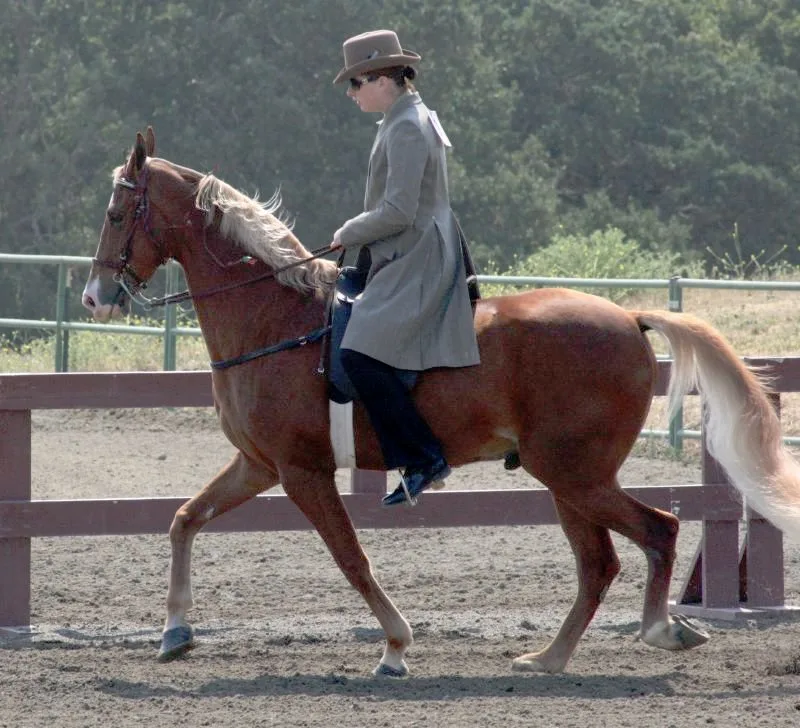
Photo: Just chaos · CC BY 2.0 · Wikimedia Commons
Horse breed
Tennessee Walking Horse
The Tennessee Walking Horse was developed in the middle of Tennessee in the nineteenth century, bred from Narragansett Pacers, Standardbreds, Morgans, and Thoroughbreds and other saddle stock. Planters and farmers in the region wanted a comfortable, sure-footed riding horse that could cover long distances on rough ground and still be pleasant at the end of a working day. The breed was formally recognized in 1935, and its signature gait, the running walk, grew out of that purpose.
Tennessee Walkers are known for a smooth, four-beat running walk that gives the rider a level, gliding ride, along with a flat walk and a canter. Most are willing and people-oriented, and many are well suited to first-time owners who want a comfortable trail partner. They can be spirited under saddle, so a calm, consistent rider brings out their best. Their gait is a big part of their appeal, and many owners enjoy riding them at a relaxed pace over long stretches.
Day to day, a Walker needs regular riding or work, plus turnout to stretch its legs and socialize. They do best with herd contact and attentive daily care. Expect time spent on grooming, hoof care, and feeding routines, since these horses thrive on consistency.
Good for: First-time owners, trail riders, pleasure riding
| Size | medium |
| Weight | 992–1213 lb |
| Height | 60–64 in |
| Life span | 25–30 years |
| Exercise | about 60 min a day |
| Shedding | moderate |
| Origin | United States (Tennessee) |
Plan for consistent daily care and watch their weight closely, since easy keepers can develop laminitis.
Living with a Tennessee Walking Horse
Exercise
Most healthy adult Walkers need several days a week of riding or groundwork, plus daily turnout. Too little work can leave them fresh, pushy, or prone to weight gain. Consistent exercise helps keep them balanced and comfortable to ride.
Grooming
Walkers have a short, glossy coat that is easy to maintain with regular brushing. Their manes and tails are often kept long and full, which takes regular detangling. Hooves need trimming or shoeing every four to eight weeks, and clipping is only needed for horses worked hard in winter.
At home
Walkers do well with daily turnout in a paddock or pasture, though they can also be stabled part of the day if a barn routine suits you. They are generally hardy in most climates and tolerate typical US winters with shelter. They are happiest with a companion horse and do not handle long isolation well. Most are moderate keepers, but ones in lush pasture may need weight monitoring.
Training
Walkers learn quickly and respond well to clear, patient cues. They are most often used for pleasure and trail riding, and they also compete in Tennessee Walking Horse shows where the running walk is judged. A green horse may be forward and eager at first, so expect to spend time teaching steady gaits and calm manners before asking for more advanced work.
Health
Tennessee Walkers can be prone to conditions that affect the feet and metabolism, including laminitis in those that gain weight easily. Some lines are also affected by inherited issues that vary by family. Ask a veterinarian about screening, feeding, and care suited to your individual horse.
- Laminitis
- Metabolic issues
- Hoof problems
Known tendencies, not a diagnosis: ask your vet about this breed.
The numbers for a Tennessee Walking Horse
Forage and water, adult
17–28 lb of hay a day
Forage at 1.5–2.5% of body weight at 992–1213 lb, and 10–18 gallons of water, more in heat and on hay alone. Grain only for the work being done.
What a year costs
$3,150–$5,350
Hay about $1,971, plus farrier every 6–8 weeks, routine vet, dental and dewormer. Board, lessons and showing on top; US averages.
Weather
Watch above 80°F, stop at 90°F
Blanket or shelter below 10°F. Horses mind heat more than cold: with shelter and water most are fine to about 10°F unclipped, and above a heat index of 150 (air °F + humidity %) ride early or not at all.
Where a Tennessee Walking Horse is comfortable
Easy most of the year: Alabama, Alaska, Arkansas, California, Colorado, Connecticut, Delaware, Florida, Georgia, Hawaii, Idaho, Illinois, Indiana, Iowa, Kansas, Kentucky, Louisiana, Maine, Maryland, Massachusetts, Michigan, Minnesota, Mississippi, Missouri, Montana, Nebraska, New Hampshire, New Jersey, New Mexico, New York, North Carolina, Ohio, Oregon, Pennsylvania, Rhode Island, South Carolina, South Dakota, Tennessee, Vermont, Virginia, Washington, Washington, DC, West Virginia, Wisconsin, Wyoming.
Summer needs care (early rides, shade, fans): Arizona, Nevada, Oklahoma, Texas, Utah.
Winter needs care (blanket, shelter, water that is not frozen): North Dakota.
From typical July highs and January lows by state and this breed's heat and cold limits. Shade, shelter and water change everything; this is about turnout and work.
Right now
Latest feed recalls
Multiple Brand Names: Chicken Feed, Swine Feed, Cattle Feed, Horse Feed
ADM Animal Nutrition · Apr 1 · Specific lots may contain elevated levels of calcium, phosphorus, magnesium, sodium and/or chloride and may harm chickens, swine, beef cattle and equine.
Recent research
Ultrasound-guided, minimally invasive, biceps brachii tenotomy in a standing horse
Veterinary surgery : VS · 2026
Additional evidence supports GRM6 p.Thr178Met as a cause of congenital stationary night blindness in three horse breeds
Veterinary ophthalmology · 2024
Comments on 'Whole-genome sequencing identifies missense mutation in GRM6 as the likely cause of congenital stationary night blindness in a Tennessee Walking Horse'
Equine veterinary journal · 2021
Veterinary papers that mention the breed, from PubMed.
Rescue a Tennessee Walking Horse
Shelters and breed rescues list Tennessee Walking Horses and Tennessee Walking Horse mixes every week. Search adoptable Tennessee Walking Horses on Petfinder → New to the breed? The first-horse kit →
Is a Tennessee Walking Horse right for you?
- Yes if you want a smooth, comfortable trail horse
- Yes if you ride regularly and enjoy a people-oriented partner
- Think twice if you can only ride occasionally
- Think twice if you want a very laid-back horse with no spirit
- Yes if you plan to show or enjoy the running walk
Questions owners ask
Are Tennessee Walking Horses good for beginners?
Many are, especially calm, well-trained individuals. Their smooth gait is comfortable, but a green horse can be forward, so work with a knowledgeable trainer.
How much does a Tennessee Walking Horse cost?
Prices vary widely with training, pedigree, and show record. Pleasure-bred horses are often less expensive than show-bred horses, so compare sellers carefully.
How tall are Tennessee Walking Horses?
Most stand roughly 15 to 16.3 hands at the withers. Height varies by bloodline and individual.
How long do Tennessee Walking Horses live?
With good care, many live into their mid-to-late twenties or beyond. Regular veterinary and farrier care supports a long life.
Are Tennessee Walking Horses easy keepers?
Many are easy keepers and can gain weight on rich pasture. Monitor body condition and diet closely to prevent metabolic problems.
Similar breeds
Written by Hoofdeck editors · updated Nov 13, 2026 · facts from Wikidata and Wikimedia Commons; health notes are general veterinary guidance, not a diagnosis.