
Horse breeds / Namib Desert Horse
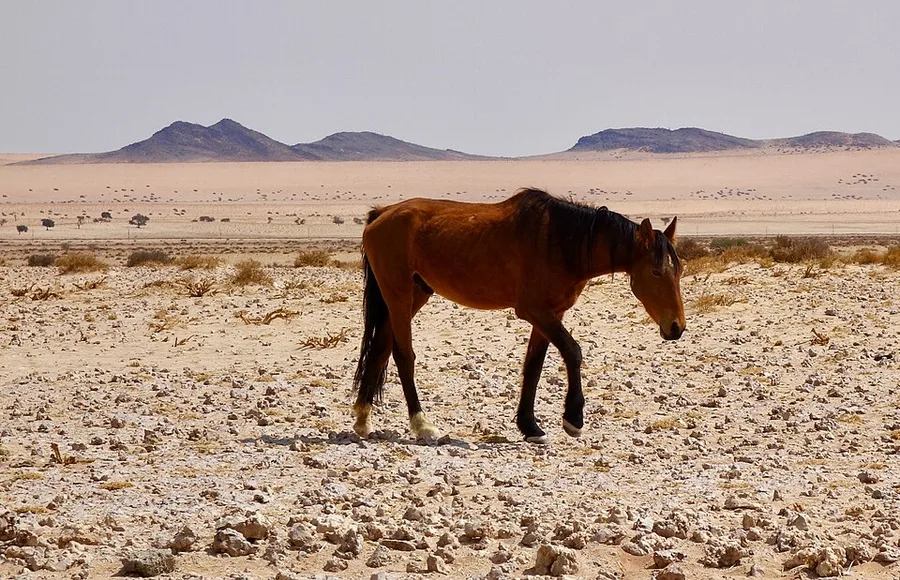
Photo: Sonse · CC BY 2.0 · Wikimedia Commons
Horse breed
Namib Desert Horse
The Namib Desert Horse is a feral population living in the Namib Desert of southwestern Namibia, descended from horses brought to the region by German colonial troops and settlers in the early twentieth century, and later from animals abandoned or released when the colonial era ended. These horses are not a formally bred breed in the usual sense, and they were never developed for a specific riding or working purpose. Their significance lies in their survival in one of the harshest environments on earth, and they are protected in the Namib-Naukluft region.
As a managed-wild or feral herd, Namib Desert Horses are not domestic riding animals and are not generally suited to ownership, training, or riding by the public. They are wary of people and should be observed from a distance rather than handled. Keepers and visitors are advised to respect their wild status and the rules that protect them.
Day to day, these horses depend on sparse grazing, scarce water, and the ability to travel long distances in search of both. Their survival rests on natural conditions and careful protection of the desert habitat, not on daily human care. Anyone interested in the herd should contact Namibian conservation authorities before any involvement.
Good for: Wildlife observers, conservation supporters
| Shedding | moderate |
| Origin | Namibia |
Namib Desert Horses are a protected wild population and are not suitable for private ownership or first-time riding.
Living with a Namib Desert Horse
Exercise
These horses cover long distances naturally as they search for water and grazing across the desert. Their activity is set by the environment, not by a daily routine. Confinement or restricted movement is not part of how they live, and they are not managed with set exercise schedules.
Grooming
Namib Desert Horses are not groomed or clipped by people. Their coats are shaped by the desert climate and by natural wear. Hoof care is not provided by owners, since the horses wear their feet down through natural travel over rough ground.
At home
Namib Desert Horses live free in the desert and are not kept in stables or paddocks. They have shown remarkable hardiness, surviving long dry periods with little water and sparse forage. They live in social herds and do not do well when isolated. They are not kept as easy or hard keepers under domestic conditions, and they should not be fed or handled as pets.
Training
Namib Desert Horses are not trained for riding, driving, or competition, and they are not a practical choice for a green horse or an owner looking for a riding partner. Their behavior is shaped by wild survival, and they tend to avoid people. Any interest in working with them should go through conservation authorities.
Health
Feral horses in harsh desert conditions face risks from drought, poor forage, and injury. Specific conditions are not well documented for this population. Anyone concerned about the welfare of these horses should ask a vet or a Namibian conservation expert for guidance.
- Drought stress
- Poor forage
- Injury from rough terrain
Known tendencies, not a diagnosis: ask your vet about this breed.
The numbers for a Namib Desert Horse
Forage and water, adult
16–26 lb of hay a day
Forage at 1.5–2.5% of body weight at 882–1213 lb (typical for the type), and 9–17 gallons of water, more in heat and on hay alone. Grain only for the work being done.
What a year costs
$3,050–$5,200
Hay about $1,840, plus farrier every 6–8 weeks, routine vet, dental and dewormer. Board, lessons and showing on top; US averages.
Weather
Watch above 80°F, stop at 90°F
Blanket or shelter below 10°F. Horses mind heat more than cold: with shelter and water most are fine to about 10°F unclipped, and above a heat index of 150 (air °F + humidity %) ride early or not at all.
Where a Namib Desert Horse is comfortable
Easy most of the year: Alabama, Alaska, Arkansas, California, Colorado, Connecticut, Delaware, Florida, Georgia, Hawaii, Idaho, Illinois, Indiana, Iowa, Kansas, Kentucky, Louisiana, Maine, Maryland, Massachusetts, Michigan, Minnesota, Mississippi, Missouri, Montana, Nebraska, New Hampshire, New Jersey, New Mexico, New York, North Carolina, Ohio, Oregon, Pennsylvania, Rhode Island, South Carolina, South Dakota, Tennessee, Vermont, Virginia, Washington, Washington, DC, West Virginia, Wisconsin, Wyoming.
Summer needs care (early rides, shade, fans): Arizona, Nevada, Oklahoma, Texas, Utah.
Winter needs care (blanket, shelter, water that is not frozen): North Dakota.
From typical July highs and January lows by state and this breed's heat and cold limits. Shade, shelter and water change everything; this is about turnout and work.
Right now
Latest feed recalls
Multiple Brand Names: Chicken Feed, Swine Feed, Cattle Feed, Horse Feed
ADM Animal Nutrition · Apr 1 · Specific lots may contain elevated levels of calcium, phosphorus, magnesium, sodium and/or chloride and may harm chickens, swine, beef cattle and equine.
Rescue a Namib Desert Horse
Shelters and breed rescues list Namib Desert Horses and Namib Desert Horse mixes every week. Search adoptable Namib Desert Horses on Petfinder → New to the breed? The first-horse kit →
Is a Namib Desert Horse right for you?
- Yes if you want to observe horses in their natural desert habitat
- Yes if you are interested in conservation and wild populations
- Think twice if you want a riding or pet horse
- Think twice if you want to handle or train horses daily
- Think twice if you expect a horse you can keep at home
Questions owners ask
Are Namib Desert Horses good for beginners?
No. They are wild and wary of people, and they are not trained or handled as riding horses. Beginners should look at domestic breeds suited to riding.
How tall are Namib Desert Horses?
Reliable height figures for this feral population are not well documented. Heights vary with the herd and the desert conditions they live in.
How long do Namib Desert Horses live?
Life span is not well documented for this population. Their survival depends on the harsh desert environment and natural conditions.
What are Namib Desert Horses used for?
They are not used for work, riding, or sport. They are a protected wild population valued for conservation and observation.
Are Namib Desert Horses easy keepers?
They are not kept by owners. They live on sparse natural forage and water in the desert, and should not be fed or managed as domestic horses.
Written by Hoofdeck editors · updated Nov 13, 2026 · facts from Wikidata and Wikimedia Commons; health notes are general veterinary guidance, not a diagnosis.